Making the Perfect Tank Head
When specifying pressure vessels or storage tanks, the end-cap geometry — the “tank head” or “end head” — plays a critical role in strength, cost, manufacturability, and performance.
In this post we’ll explore two of the most frequently used types of tank heads: semi-elliptical (2:1 elliptical) and ASME flanged & dished. By understanding their differences in shape, pressure-handling ability, material thickness, and typical application, you’ll be better positioned to choose the right head for your tank-end application.
And if you already know what you’re looking for, but need higher conforming rates or better performance, our team can help! Our engineers use finite element analysis to determine the optimal material, thickness, and forming pressure to improve accuracy and, more importantly, repeatability and durability. We can also use FEA to calculate real stress, going beyond pass/fail acceptance criteria.
You can learn more about what makes FluidForming Americas' tank heads unique here
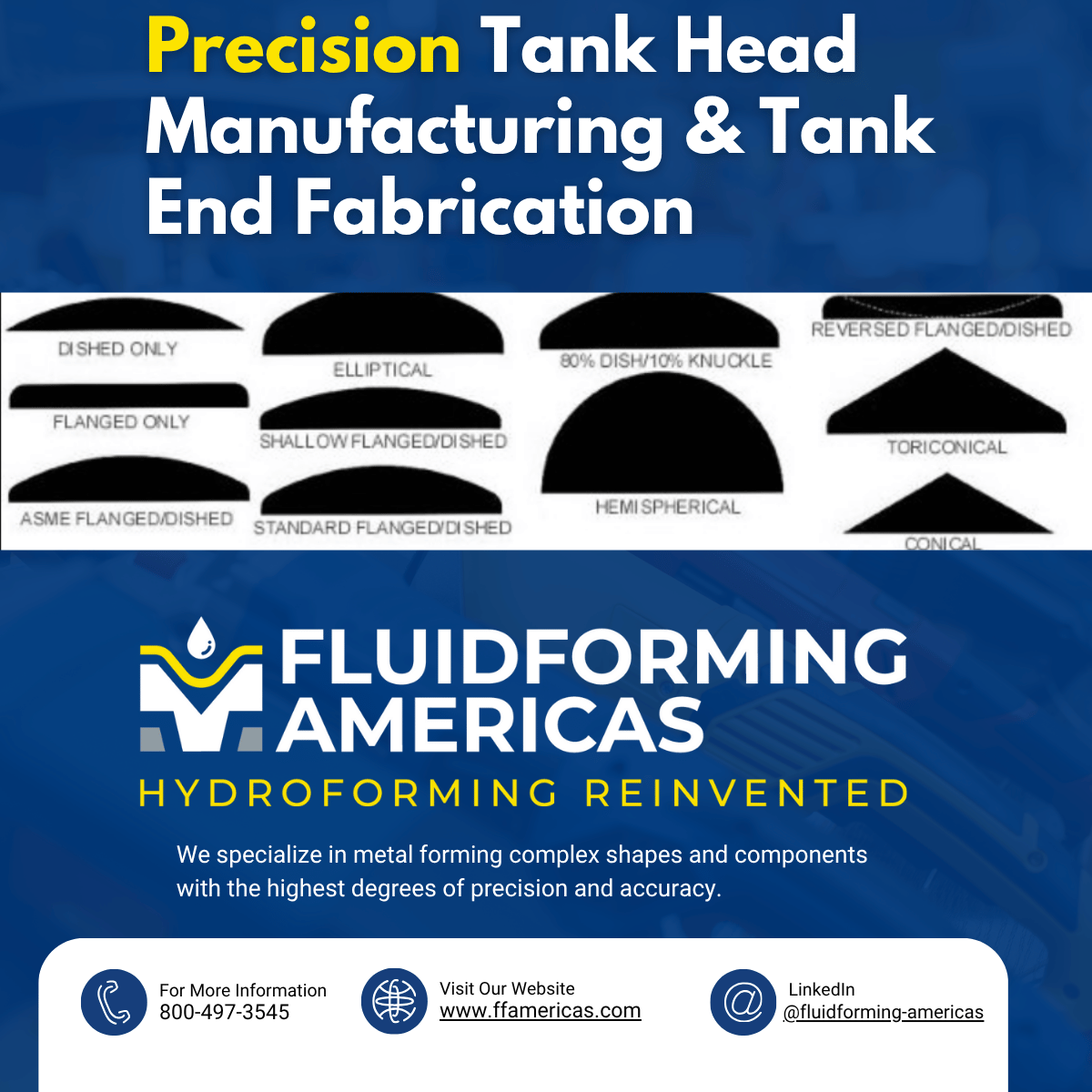
Semi-Elliptical (2:1 Elliptical) Tank Heads
The semi-elliptical head or elliptical head features a familiar cupped profile where the dish height is a fraction of the diameter — commonly a 2:1 ratio of diameter to depth.
Shape & Manufacturing of Semi-Elliptical Tank Ends
The geometry provides excellent structural efficiency when compared to flatter profiles. The signature curvature helps distribute stresses from internal pressure more evenly across the dish compared to a flatter profile.
Strength & Thickness of 2:1 Ellipticals
Because of their efficient shape, semi-elliptical heads can use thinner wall material than some flatter heads at the same pressure rating.
How Semi-Elliptical Tank Ends Are Used
- These heads are a solid general-purpose choice for pressure vessels and storage tanks where moderate height is acceptable.
- They strike a balance: good pressure performance, moderate cost, reasonable height.
- One limitation: the height is typically greater than flatter-profile heads, so they may sit a little higher.
ASME Flanged & Dished Tank Heads
The ASME flanged and dished head is characterized by a dish with a straight flange perimeter and a relatively low profile compared to deeper dish variants.
Shape & Manufacturing of Flanged & Dished Tank Ends
Because of the flatter dish section and the flanged rim, the F&D head style allows for a lower external height. In other words, if space is a consideration, these ends may be a good fit.
Strength & Thickness of F&D ends
Because they lack the curvature and complex geometry of elliptical tank ends, the structural efficiency is typically lower than deeper dishes. That means the dish must often be thicker to achieve the same pressure rating.
How F&D Tank Ends Are Used
- When space is limited, these lower profile ends may work better than elliptical ends.
- The flatter profile may simplify interior access or mounting of internal equipment.
- Increased material thickness can add cost and weight and may require higher forming pressures.
Making the Right Choice for Your Tank Head
Here are a few common considerations:
- Pressure rating & safety: Higher pressure applications benefit from shapes that distribute stress more evenly (e.g., semi-elliptical or hemispherical).
- Vertical space & head height: If tank height is limited, a low-profile head like F & D or flat may be preferred despite the trade-offs.
- Material cost & thickness: Curved shapes allow thinner material for equivalent pressure, reducing weight and sometimes cost.
- Manufacturing & fit-up: In advanced forming methods (such as the hydroforming-derived process used by FluidForming Americas) the consistency of forming, minimal tool marks, and material distribution become important.
- Internal equipment & clearance: If internal mixers or other devices need to be mounted lower in the head region, flatter heads may support that more easily.
- Surface finish & custom geometry: If branding, embossing, or exotic materials are required, then the forming method and head geometry must accommodate those features with precision.
Whether you’re looking for a forming process that offers you more repeatability and accuracy, or you’re not quite sure which option is right for your function, our team can help optimize part formation.
Level up your metal forming manufacturing solutions and elevate your tank end production capabilities — contact us today to learn more about our precision forming solutions for the tank end manufacturing industry. Or, give us a call at 1-800-497-3545.
FluidForming Americas, Inc. is a member of the Precision Metal Forming Association and is AS9100 Rev D, ISO 9001:2015 certified. ITAR registered.